

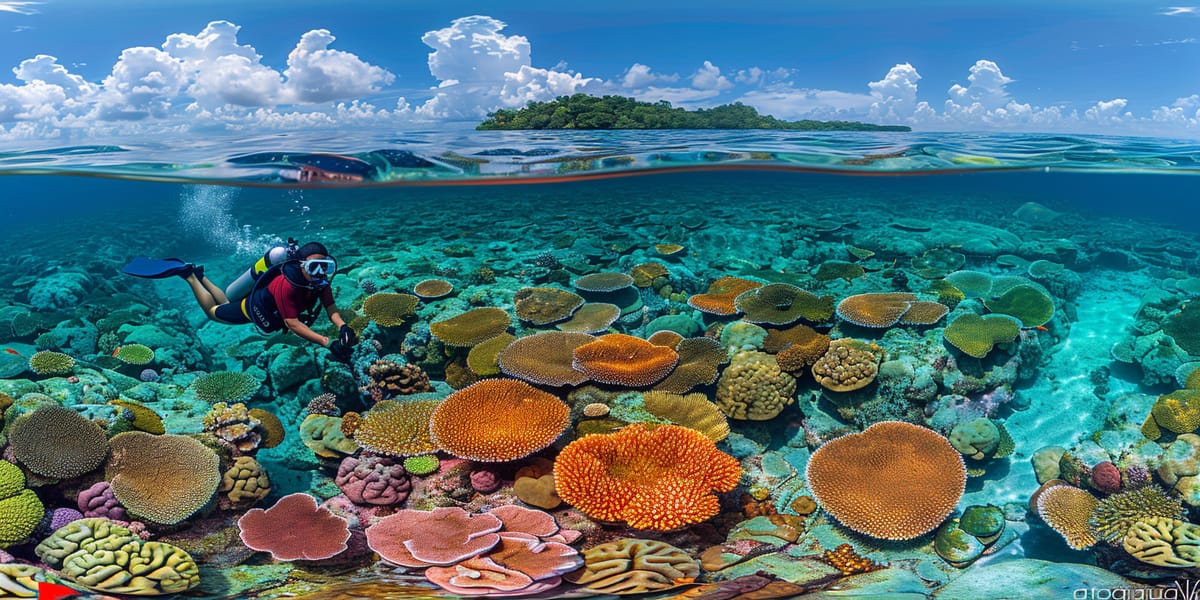
The Maldives is often described in postcards: a thin chain of emerald islands floating in an impossible blue. But for Maldivians, the ocean is not just scenery—it is geography, economy, and risk, all at once. The country’s greatest protector is also its greatest uncertainty. And the Maldives’ most important “wall” isn’t made of concrete. It’s alive.
Coral reefs are frequently framed as nature’s decoration, but in an atoll nation they function as infrastructure. Reefs slow incoming waves, reduce erosion, and help stabilize beaches. They are the reason many islands exist in their present form, shaping lagoons and shielding shorelines. When reefs are healthy, they break wave energy before it reaches land. When reefs weaken, that protective buffer thins—and the cost of living on the edge rises in ways that can’t always be calculated on a balance sheet.
A reef’s job is to take the hit
To understand why reefs matter, imagine a reef crest as a sacrificial shield. It absorbs wave force day after day, year after year, long before the sea ever touches an island’s foundations. This is what makes the Maldives unique: the frontline of coastal protection is often underwater and out of sight.
That makes reefs easy to forget—until they fail. Bleaching events, disease, pollution, physical damage, and warming seas reduce coral cover and complexity. As the reef structure erodes, waves travel faster and hit harder. For communities, this can look like beaches that don’t “return” after monsoon seasons, shorelines that retreat year by year, and an escalating dependence on expensive engineering.
The sand cycle: why beaches aren’t permanent
Many visitors assume the Maldives’ beaches are fixed features, like sidewalks. In reality, sand is constantly moving. Currents and waves rearrange it around islands in a dynamic cycle. Healthy reefs contribute to the creation and retention of sand by supporting ecosystems that generate carbonate sediments. When reef health declines, the sand budget can shift. Beaches may narrow, sand bars can migrate, and the coastline becomes more sensitive to storms.
This isn’t just an environmental problem. It’s a housing problem. A utilities problem. A national security problem. The shoreline is the country’s foundation—and every meter matters.
The human pressure point
The Maldives is also a nation that must build to survive: homes, harbors, seawalls, airports, and tourism infrastructure. The challenge is that coastal development can unintentionally weaken the very systems that keep islands stable. Dredging, sedimentation, and poorly planned coastal modifications can stress corals, reducing light and smothering reef organisms. Wastewater leakage and nutrient runoff fuel algal growth that competes with corals. Anchor damage and careless marine activity can break fragile structures that take decades to regenerate.
The story isn’t “development versus environment.” It’s “development that lasts versus development that loses the ground beneath it.”
What reef protection looks like in practice
Reef protection in 2026 cannot be a slogan. It needs to be a set of visible, enforced habits:
- Strong wastewater management that matches population growth and resort capacity, especially on densely populated islands.
- Marine zoning that recognizes reefs as critical assets, not “empty” water.
- Better harbor and dredging standards, including timing, monitoring, and sediment control.
- Responsible tourism practices—moorings instead of anchors, education instead of guesswork.
- Community-led stewardship where local fishers, dive operators, councils, and youth groups become the first responders for reef health.
Reef restoration—coral nurseries, transplantation, and assisted recovery—can help, but it is not a replacement for protection. Restoring a reef is like repairing a road while heavy trucks still drive over the broken section. Prevention remains cheaper than repair.
The Maldives’ advantage: clarity
If you live in a large country, environmental collapse can feel abstract. In the Maldives, it’s measurable on the shoreline. That clarity is painful—but it’s also powerful. It means policy can be grounded in visible outcomes: beach stability, lagoon health, fisheries resilience, disaster risk reduction. We can define “success” in a way that is immediate and real.
The reef is not just a habitat. It is a national asset that works for us every day, silently, without invoices. Protecting it is not an environmental luxury. It is the maintenance plan for a country.